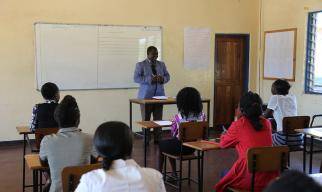

Despite being the primary point of contact for learners around the world, many teachers often lack the skills, tools, and support they need to effectively teach children. Traditional “chalk and talk” pedagogies do not allow for tailoring to children's learning needs, which is critical for learning. Furthermore, even if teachers want to tailor instruction to their students’ learning levels, they are often constrained by unrealistic curricula. As a result, millions of students in school lack basic reading and math skills, with poor children learning the least.
Teaching at the Right Level (TaRL) is an evidence-based initiative that enhances the quality of primary education through improving teacher capacity to improve children’s foundational skills and by supporting teachers through mentoring and monitoring to ensure their success in the classroom. Six randomized evaluations in India show that TaRL has led to the largest learning gains rigorously measured in education literature. However, TaRL’s success in India is attributed to the availability of many staff from non-governmental organizations (NGOs) that support government-led program activities.
Given that this level of NGO support is not feasible in the target countries of Côte d'Ivoire, Nigeria, and Zambia, significant research and adaptation is needed to better understand how these mentoring systems work and how they can be leveraged in lower resource settings with less NGO support.
This project is a critical window for research that is directly relevant and useful to countries that are scaling the approach. It will improve understanding of existing systems, pilot new innovations to the TaRL mentoring and monitoring approaches, and rigorously test the best innovations at scale in government systems.
Project Stats